
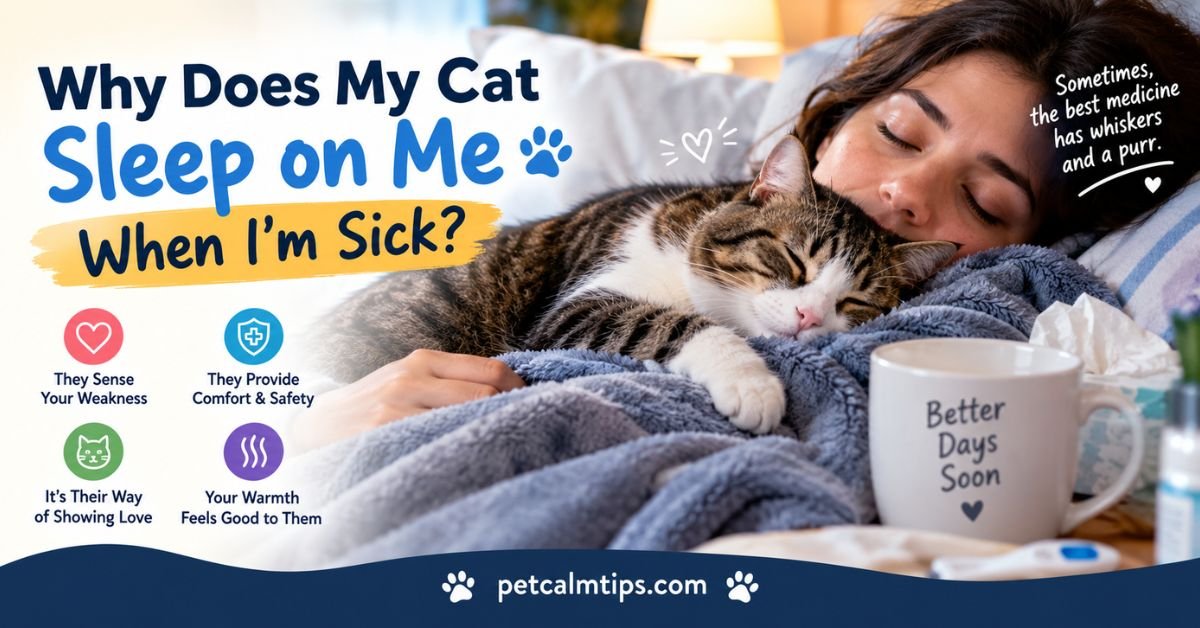
Why Does My Cat Sleep on Me When Im Sick? (7 Real Reasons)
Quick Answer
Your cat sleeps on you when you’re sick mainly because you’re warmer, quieter, and more predictable than usual. You’re also staying in one spot for hours, which cats love. She may notice changes in your scent and routine too. Combined with a strong bond, these cues make you the safest, coziest place in the house. It’s usually comfort-seeking, not a warning sign.
Table of Contents
- Why Does My Cat Sleep on Me When I’m Sick?
- Cause 1: Your Body Heat Makes You a Heated Bed
- Cause 2: Your Cat Smells the Changes in You
- Cause 3: Your Routine Shifted and Your Bond Is Strong
- What to Do at Home Today: A 7-Step Plan for Sick Days
- Common Mistakes Cat Owners Make When Sick
- When to Call Your Vet Immediately
- Conclusion
- FAQs
Why Does My Cat Sleep on Me When I’m Sick?
Here’s the honest answer. Nobody can read a cat’s mind, and science hasn’t fully explained this habit.
But vets and behaviorists agree on a few strong clues. Your cat isn’t playing nurse, even though it looks that way.
Cats love warmth, routine, and safety. When you get sick, all three shift at once. You stop rushing around, you lie still for hours, and your body may run hotter. The house gets quieter, too.
To your cat, you’ve become a stable, heated, low-activity landing spot. (She doesn’t need a medical degree to know a good deal when she sees one.)
In my 12 years at a Texas shelter, I’ve seen cats choose the calmest, warmest person in the room again and again, whether that was a volunteer on a break or an adopter dozing on a bench. Sickness simply makes you the top candidate.
There’s a sensory side as well. Cats have a superb sense of smell, and illness can change how a person smells, breathes, and moves. Your cat likely notices that something is different. Whether she understands what it means is still an open question.
Here’s a quick way to see how the pieces fit together:
| Likely driver | What your cat notices | What you’ll see |
|---|---|---|
| Warmth | Fever, blankets, warm skin | She settles on your chest or belly |
| Stillness | You’ve stopped moving around | Long, deep naps on top of you |
| Scent change | Sweat, medicine, new products | Sniffing and face-rubbing |
| Routine shift | You’re home all day | Following you, extra cuddles |
| Bond | Her trusted person feels “off” | Purring, kneading, staying close |
So the short version has three parts:
- You’re warmer and more still than usual.
- You smell and sound a little different.
- Your cat already trusts you, so she moves in closer.
That’s the heart of it. The next three sections look at each cause in detail, so you can tell which one fits your cat best.
Cause 1: Your Body Heat Makes You a Heated Bed
Let’s start with the simplest reason. Cats adore warmth.
Their comfortable resting temperature is higher than ours. That’s why she claims the sunny windowsill, your laptop, and the warm laundry basket.
When you have a fever, your skin and core feel hotter. A blanket-wrapped, feverish human is basically a radiator with a pulse. Your cat doesn’t need to understand a fever to enjoy the benefit.
Think about your normal day. You’re up, walking around, making noise, and gone for hours. You’re a hard surface to settle on.
When you’re sick, you flip that script. You lie flat and stay put, barely moving except to cough or roll over. For a cat, that’s premium real estate.
Why the chest and stomach?
Cats often pick your chest, belly, or the spot near your neck. These areas hold heat well. They also rise and fall with your breathing, which many cats find soothing.
Some owners say their cat seems to match their breathing. It’s a lovely picture, and it fits how calming steady rhythms can be. We can’t say for certain it’s intentional.
Which cats chase heat the hardest?
Some cats are simply heat-seekers, and a few have good reasons:
- Senior cats often feel colder and look for warm laps.
- Thin cats lose body heat faster.
- Cats with arthritis may love warm spots for sore joints.
- Short-haired cats have less insulation than fluffy breeds.
Pay attention to timing. If the extra cuddling started before you got sick, or it continues long after you’ve recovered, heat alone may not explain it. That’s worth a closer look, and I’ll cover it in the vet section.
For most households, though, the answer is wonderfully simple. You got warm, you got still, and your cat noticed.
You can use this to your advantage, too. A cat on your lap is a free heating pad, and many people find that comfort genuinely helps them rest. Just make sure you can still breathe easily and move when you need to.
Cause 2: Your Cat Smells the Changes in You
Cats live in a world of scent. Their sense of smell is far sharper than ours, and they use it to understand people, places, and other animals.
When you’re sick, your scent can change. Fever, sweating, medication, and different foods can all alter how you smell.
You’re probably using unfamiliar products, too. Think menthol rub, tissues, tea, soup, or a new body wash. Your cat notices every bit of it.
What your cat may be sensing
Here’s what’s reasonable to say without overclaiming. Cats can detect small scent changes we can’t, and they also notice shifts in how you breathe, move, and sound.
Many owners feel strongly that their cats “know” when they’re ill. Researchers haven’t proven that cats diagnose disease. But it’s fair to say your cat probably picks up that something is different.
She likely doesn’t know it’s a cold. She just knows you aren’t the usual you.
Why different can mean closer
Cats often respond to change in one of two ways. Some hide, and others stick close to their trusted person and check in.
A familiar human who smells a bit off can trigger curiosity. Sleeping on you lets her stay near, keep watch, and soak up your scent.
Scent works both ways
Cats mark the people and things they love by rubbing and sleeping on them. When she lies on you, she leaves her own scent behind. Your smell and hers blend into a shared, familiar scent.
It’s a bit like a cat’s version of a group hug. It helps her feel secure, and it’s a big part of how cats show attachment.
A safety note on strong smells
Some scents bother cats, and some are unsafe. Certain essential oils are toxic to cats, and heavy menthol or strong cleaning products can irritate her nose and lungs.
If you’re using diffusers, balms, or vapor rubs while sick, keep them away from her space. Ask your vet before using anything aromatic around her.
So yes, scent probably plays a role. Just remember that what looks like caring is also curiosity, comfort, and habit rolled together.
Cause 3: Your Routine Shifted and Your Bond Is Strong
Now for the emotional side. This is where it gets sweet, and a little more layered.
Cats are very sensitive to routine. They like to know when meals happen, when you wake up, and when the house goes quiet.
When you’re sick, your routine falls apart. You skip the morning rush, and you might not leave the house at all.
For a cat who usually spends the day alone, that’s a jackpot. Her favorite person is home and horizontal.
The attachment piece
Published research on cats and their owners suggests that many cats form real attachment bonds with their people. Your cat sees you as a source of safety.
When something feels off, she may move closer to that safe person. It’s the same reason some cats follow you from room to room, and it doesn’t take illness to trigger it.
Reading the room
Cats also pick up on mood and energy. You’re moving slowly, speaking softly, and sighing a lot.
That calm, low-energy atmosphere can be relaxing for a cat. There’s less noise and fewer sudden movements, so she feels at ease. Some cats even get gentler and more cuddly around a tired or sad owner.
What about the purring?
Many cats purr when they’re close to you. People often assume purring always means happiness, but cats also purr to soothe themselves when they’re stressed.
Some researchers have suggested purring may help with self-comfort. That idea is still debated, so I wouldn’t treat it as settled.
If your cat purrs on your chest while you’re ill, she may be happy, relaxed, or both. You don’t need to over-analyze it.
Sometimes it’s simply about her
Here’s a truth that’s a little less poetic. You’re available. A sick day means more lap time, and your cat is smart enough to take it.
Honestly, that’s fine. Cats are allowed to be opportunists, and you’re getting comfort out of the deal too.
What to Do at Home Today: A 7-Step Plan for Sick Days
You want the cuddles without the problems. Here’s a simple plan you can start today.
Step 1: Let her stay, if you feel up to it.
Warm, relaxed contact is usually fine. If she’s heavy or you can’t breathe comfortably, gently move her to your side.
Step 2: Wash your hands often.
Do it after coughing, sneezing, or blowing your nose. Wash again before you touch her food or bowls.
Step 3: Keep her routine steady.
Feed her at the usual times, even when you feel awful. Predictable meals help a cat cope with a disrupted household.
Step 4: Keep the litter box clean.
If you’re too weak to scoop, ask a family member or friend. A dirty box stresses cats and can lead to accidents or avoidance.
Step 5: Set up a cozy spot nearby.
Place a soft blanket or cat bed right next to you. She can stay close without sitting on your face or chest, and you’ll sleep better.
Step 6: Lock up medications and remedies.
Keep pills, cough drops, creams, and teas out of her reach. Many human medicines are dangerous to cats, even in tiny amounts.
Step 7: Check in on her, too.
Each day, look at her eating, drinking, and litter habits. A sick owner can easily miss early signs in a pet.
A quick note on contagion
Most common colds and flu in people aren’t a major worry for cats. Still, a few illnesses can pass between people and pets, so ask your doctor if you have anything unusual or serious.
If you test positive for something specific, ask both your doctor and your vet for guidance. Don’t rely on guesses.
If you’re very ill, line up backup help for food, water, and litter. That’s the most useful thing you can do for her.
9 Common Mistakes Cat Owners Make When Sick
I’ve watched loving owners make these slips. None of them make you a bad cat parent, but they’re worth avoiding.
Mistake 1: Assuming the clinginess is always cute.
A sudden behavior change can point to a health issue. If she’s clingier than normal even when you’re well, pay attention.
Mistake 2: Skipping meals and chores.
When you feel terrible, it’s tempting to let her bowl run low. Cats get stressed quickly when their routine breaks down.
Mistake 3: Using strong scents near her.
Diffusers, essential oils, and heavy menthol products can irritate her. Some are toxic to cats, so keep them out of her space.
Mistake 4: Leaving medication within reach.
Cats are curious. A dropped pill or an open ointment tube can become an emergency fast.
Mistake 5: Sharing food from your plate.
Soup, broth, and tea can contain onion, garlic, or other ingredients that aren’t safe for cats. Stick to her normal food.
Mistake 6: Locking her out of the bedroom.
Some owners shut the door out of worry. That’s understandable, but it can upset a bonded cat. Set gentle boundaries and offer a bed nearby instead.
Mistake 7: Letting her sleep on your face.
It’s cute, but it’s not great when you’re congested. Blocked breathing at night can make you feel worse.
Mistake 8: Assuming she’s fine because she’s cuddly.
A sick person, strange smells, and a disrupted schedule can stress a cat. Cuddling doesn’t always mean calm.
Mistake 9: Ignoring your own limits.
If you’re too ill to care for her properly, say so and ask for help. That’s responsible, not weak.
The big takeaway? Keep things simple. Stick to her routine, keep hazards out of reach, and enjoy the closeness when it feels safe.
When to Call Your Vet Immediately
Everything above is general advice. This section is different, because some situations need a professional.
A cat who sleeps on you while you’re sick is usually fine. But clinginess can also be a quiet sign that the cat feels unwell. Cats hide pain very well, and behavior changes are often the first clue.
Call your vet right away if you notice:
- Trouble breathing, open-mouth breathing, or very fast breathing at rest
- Repeated vomiting, or vomiting with lethargy
- No eating for a full day, or no drinking
- Straining in the litter box, or crying while trying to urinate
- Blood in vomit, urine, or stool
- Sudden collapse, weakness, or loss of balance
- Pale or bluish gums
- Hiding combined with other changes
Call your vet within a day or two if:
- She’s suddenly far clingier than usual, even when you’re healthy
- She seeks heat constantly, especially if she’s older
- She’s losing weight or drinking much more than normal
- Her coat looks dull, or she stops grooming
- She has sneezing, watery eyes, or nasal discharge
If you’re sick too
If you’re too unwell to judge her condition, ask a friend or relative to check on her. You can also phone your vet’s office for advice. After hours, look for a local emergency clinic.
I’ve seen owners wait because they felt embarrassed or exhausted. Please don’t. Vets would much rather hear “it was nothing” than see a cat who waited too long.
This article isn’t a substitute for a veterinary exam. If something feels off, trust your gut and make the call.
Conclusion
So, why does my cat sleep on me when I’m sick? In most cases, it’s a blend of warmth, comfort, scent, routine, and trust.
You’re warmer, quieter, and lying still. Your cat notices something different, and she moves toward the person who feels like home. That’s not a warning sign. It’s affection with good timing.
Your next step is simple. Set up a soft bed beside you, keep her feeding and litter routine steady, and lock away your medications. Then watch her eating, drinking, and litter habits for a few days.
If anything looks off, call your vet. Otherwise, enjoy the company. Rest well, and let your little heater do her job.
Explore More Expert-Reviewed Pet Care Guides: Can Cats Drink Lactose Free Milk?
FAQs
1: Can cats really sense when you’re sick?
Cats can likely notice changes in your scent, breathing, movement, and routine. That’s enough for them to realize something is different. Whether they understand it as “illness” hasn’t been proven. Your cat probably senses a shift and responds by staying close to her trusted person.
2: Is it safe to let my cat sleep on me when I’m sick?
Usually, yes. Gentle contact is fine for most people and cats. Wash your hands often, keep her off your face, and move her if you can’t breathe comfortably. If you have a serious or unusual illness, or a weakened immune system, ask your doctor and your vet what precautions make sense.
3: Can I give my cold to my cat?
Common human colds and flu aren’t usually a big concern for cats, since cats have their own separate respiratory viruses. Still, some illnesses can pass between people and pets. If you have something specific, such as a confirmed infection, ask your doctor and your vet whether you should limit contact with your cat.
4: Why does my cat sleep on my chest?
Your chest is warm, soft, and moves gently with each breath. Many cats find that rhythm soothing, like a built-in lullaby. It’s also close to your face and scent, which makes her feel secure. Chest-sleeping is common even when you’re healthy, and it often signals a strong bond.
5: Why is my cat suddenly clingy when I’m not sick?
A sudden change in clinginess can have many causes, including stress, a new routine, boredom, aging, or a medical issue. If she’s also eating less, drinking more, hiding, or losing weight, call your vet. When the clinginess comes with other changes, it’s worth checking, because cats often hide illness until it’s advanced.
6: Why does my cat purr when I’m ill?
Cats purr when they’re relaxed, but also when they’re stressed and trying to calm themselves. On your chest, she’s probably content, comforted, or a bit of both. Purring alone doesn’t tell you much, so watch her body language too. Soft eyes and a loose posture usually mean she’s happy.
2 Comments