
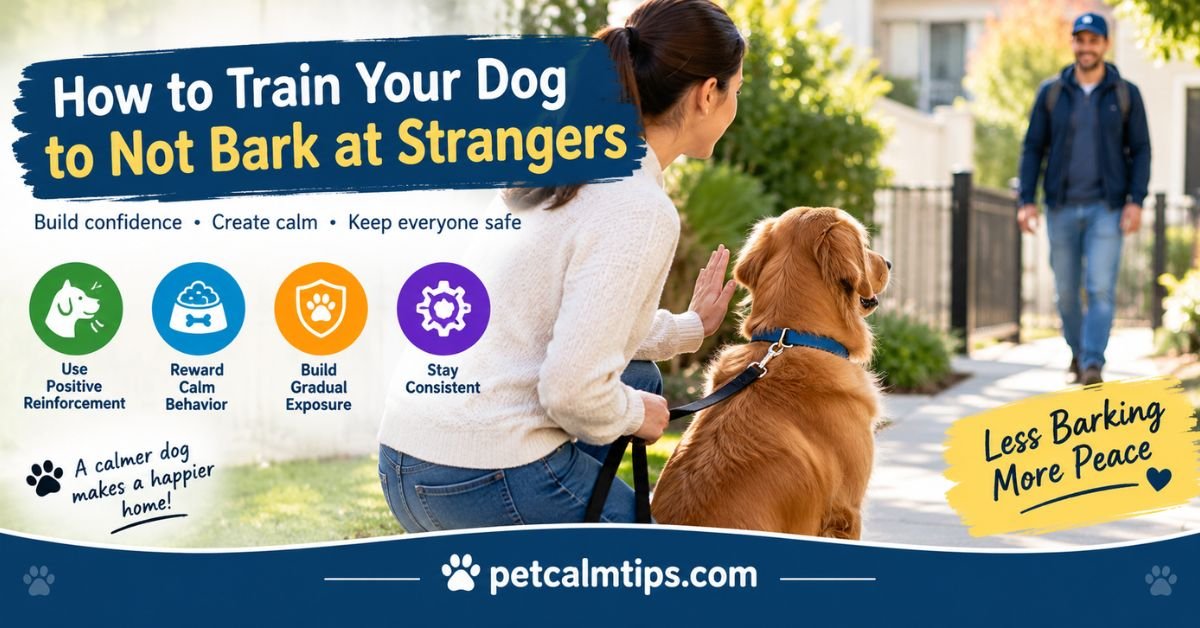
How to Train Dog to Not Bark at Strangers: (Without Yelling)
Quick Answer
To train a dog not to bark at strangers, first find out why your dog barks: fear, guarding, or excitement. Then teach a calm alternative behavior, like going to a mat, while rewarding quiet moments with treats. Start at a distance where your dog stays relaxed, and move closer slowly over days or weeks. Consistency matters more than intensity. Never punish barking, since that raises stress and makes the problem worse.
Table of Contents
- Why Does My Dog Bark at Strangers?
- Cause 1: Fear and Insecurity
- Cause 2: Territorial and Protective Barking
- Cause 3: Over-Excitement and Frustration
- What You Can Do At Home Today: 7-Step Plan
- Common Mistakes Pet Owners Make
- When to Call Your Vet Immediately
- Final Verdict: How to Train Dog to Not Bark at Strangers
- FAQs
Why Does My Dog Bark at Strangers?
Barking is communication. It isn’t bad behavior, and it isn’t your dog trying to embarrass you.
Dogs bark at strangers to say something: “I’m scared,” “this is my space,” or “I’m too excited to cope.” Your job is to figure out which message you’re hearing.
Dogs also don’t understand that a delivery driver is harmless. To them, an unfamiliar person approaching the house is an unknown, and unknowns can feel risky. (Some breeds, like herding dogs, guardians, and many terriers, were literally bred to sound the alarm.)
Several things make strangers-barking more likely:
- Limited early socialization. Puppies who meet few people between roughly 3 and 14 weeks often grow wary of unfamiliar faces.
- Genetics and breed tendencies. Some dogs are simply more alert and vocal.
- Past experiences. A bad encounter can leave a lasting impression.
- Accidental reinforcement. If a stranger walks away every time your dog barks, your dog learns that barking works.
- Lack of exercise or mental stimulation. A bored dog finds the window very entertaining.
That last one surprises many owners. A dog with pent-up energy has more reasons to explode at the first passerby.
You’ll also see body language clues. A dog with a stiff body, raised hackles, and a hard stare is likely guarding. A dog with a tucked tail, lip licking, and backing away is probably afraid. A wiggly dog with a loose body and a high-pitched bark is often just overexcited.
Learning to read these signals helps you pick the right fix. Training a fearful dog like a guarding dog can backfire, so take a few days to simply observe. Jot down when the barking happens, how far away the stranger is, and what your dog’s body looks like.
Cause 1: Fear and Insecurity
Fear is the most common driver I see, and it’s the one owners most often misread.
A fearful dog may look aggressive. The barking is loud, the lunging is dramatic, and the whole display says “stay away.” But underneath, the dog is saying “please don’t come closer.”
This is called distance-increasing behavior. Barking works for a scared dog because the stranger usually leaves. That gives the dog relief, which strengthens the habit.
Signs your dog’s barking is fear-based:
- Ears pinned back or flattened
- Tail tucked or held low
- Whale eye (you can see the whites of the eyes)
- Trying to retreat before or during barking
- Shaking, panting, or lip licking
- Barking that stops quickly once the stranger leaves
How to help a fearful dog:
The goal isn’t to force your dog to “face” the fear. Flooding, meaning pushing a scared dog close to what frightens it, can make things much worse.
Instead, use counterconditioning and desensitization. That means pairing the sight of a stranger at a safe distance with something wonderful, like chicken or cheese. Over time, “stranger appears” starts to predict “treats arrive,” and the emotional reaction changes.
Keep sessions short, about five minutes. Stop before your dog gets stressed.
I once worked with a shy shepherd mix who barked at every man in a ball cap. We started by feeding her treats while a volunteer stood across a parking lot. It took three weeks before she’d take a treat at 20 feet, but she got there, and the progress held.
Don’t rush this. Fear-based barking improves through trust, not pressure. If your dog is truly panicked, a certified trainer or veterinary behaviorist can build a safe plan with you.
Cause 2: Territorial and Protective Barking
Some dogs bark because they believe they’re guarding something: the house, the yard, the car, or you.
Territorial barking often happens at the window, fence, or front door. It tends to be loudest when people approach your property, and it usually calms down once the “intruder” leaves. Your dog thinks, “I did it! I chased them away!” That’s powerful reinforcement.
Signs of territorial barking:
- Barking is worst at home and mild or absent on walks
- Stiff, upright posture with a forward lean
- Rushing to the fence, door, or window
- Barking increases when someone steps onto your property
- Your dog relaxes soon after the person is gone
Why it becomes a habit:
Every repeat of the pattern strengthens it. Mail carriers, delivery drivers, and neighbors all come and go, and your dog “wins” every time. It’s one of the most self-rewarding behaviors there is.
What helps:
Start by controlling the environment. Block your dog’s view with window film or by closing curtains. Keep your dog out of the yard when you can’t supervise. This reduces the number of rehearsals.
Then teach an incoming-visitor routine. Your dog learns that when the doorbell rings, the job is to go to a mat and wait. You reward calm, and you take over the guard duty by saying something like “Thanks, I’ve got it.”
That last part matters more than most people realize. Dogs who feel they must protect the household are often relieved when the owner takes charge calmly.
Never scold or yell. Yelling sounds like you’re barking too, which tells your dog the threat is real.
Management plus training works best here. You can’t practice calm if your dog is rehearsing chaos twenty times a day at the front window.
Cause 3: Over-Excitement and Frustration
Not every barker is scared or guarding. Some are just thrilled.
Excited barking looks different. The body is loose and wiggly, the tail is wagging, and the bark is higher-pitched and playful. Your dog wants to say hello right now, and being held back by a leash, a fence, or a closed door turns that eagerness into frustration.
This is called barrier frustration or leash reactivity from excitement. The dog isn’t unfriendly. The dog just doesn’t have the impulse control yet.
Signs of excitement-based barking:
- Loose, bouncy body and wagging tail
- Pulling toward strangers on walks
- Jumping up and whining along with barking
- Barking that spikes when people look at or talk to your dog
- Instant calm once the dog is allowed to greet
Why it develops:
Many owners unintentionally encourage this. Visitors walk in, squeal, and pet an overexcited dog. The dog learns that barking and jumping get attention and greetings. It’s a perfectly logical lesson from the dog’s point of view.
Young dogs and under-exercised dogs are especially prone to this. Adolescence, roughly 6 to 18 months, is a common peak.
What helps:
Build impulse control. Teach “sit” and “wait” as the price of every greeting. Practice with friends who are willing to ignore your dog until the dog is calm.
Increase daily exercise and mental work too. Sniff walks, puzzle feeders, and short training games drain energy in healthy ways. A tired dog has less spare energy to spend on shouting.
And change the greeting rules. If your dog barks, the stranger turns away. If your dog sits quietly, the stranger can say hello. Your dog quickly learns which behavior gets the reward.
Everyone in your household has to follow the same rules. One person who excitedly greets the dog at the door can undo a week of work.
What You Can Do At Home Today: 7-Step Plan
Here’s a practical plan you can start tonight. Go slowly, and celebrate small wins.
Step 1: Find your dog’s threshold.
Your threshold distance is how close a stranger can get before your dog reacts. Training happens below that line, where your dog can still think and eat treats.
Step 2: Prepare high-value rewards.
Use tiny, soft treats your dog loves, like chicken, cheese, or hot dog pieces. Regular kibble often isn’t exciting enough for this work.
Step 3: Teach a “look at me” cue.
Say your dog’s name or “watch me,” and reward when your dog makes eye contact. Practice indoors first, with no strangers around. This becomes your emergency brake outside.
Step 4: Teach a mat or “go to place” routine.
Reward your dog for settling on a mat or bed. Build up to longer stays and then to calm waits while the doorbell sound plays softly. This gives your dog a job other than barking.
Step 5: Pair strangers with treats at a safe distance.
When a stranger appears and your dog notices without barking, mark with “yes” and feed a treat. Stranger appears, treat arrives. Repeat, and over time your dog starts to look at you with happy anticipation.
Step 6: Gradually decrease distance.
Only move closer when your dog is relaxed at the current distance. Progress might take days or weeks. If your dog barks, you’ve gone too fast, so increase the distance again and keep things easy.
Step 7: Practice real-life scenarios with helpers.
Ask friends to be “strangers.” Have them walk by, ignore your dog, and toss a treat without making eye contact. Eventually, practice a calm entrance into your home.
Keep it up:
- 2 to 3 short sessions daily beat one long session
- End on a success, always
- Keep daily exercise and enrichment up
- Reduce triggers between sessions with window film or a quiet room
(One more tip: log your progress. Seeing a week-by-week improvement is a big morale boost when you feel stuck.)
If you feel overwhelmed, a certified professional dog trainer using reward-based methods can coach you through these steps in person.
9 Common Mistakes Pet Owners Make
Most owners are trying their best. Still, a few well-meaning habits can quietly keep the barking alive. Here’s what I see most often.
1. Punishing or yelling.
Shock collars, spray bottles, and shouting may stop the sound for a moment, but they don’t change the feeling behind it. A fearful dog who’s punished near strangers learns that strangers predict bad things. That can turn barking into biting over time.
2. Forcing greetings.
“Just say hi, he’s friendly” is a risky line. Pushing a nervous dog to meet people increases fear and can lead to a bite. Let your dog choose.
3. Letting the dog practice the problem.
If your dog barks at the window all day, you’re rehearsing the behavior hundreds of times. Management, like blocking the view, is part of training.
4. Moving too fast.
Skipping straight to close encounters is the number one reason plans fail. Slow is fast here.
5. Inconsistent rules.
One family member allows jumping and barking at greetings, and another doesn’t. Dogs thrive on predictable patterns.
6. Using low-value treats.
If the treat isn’t worth more than the stress, your dog won’t take it. That’s useful information, not stubbornness.
7. Skipping exercise and enrichment.
A dog with little outlet will find one, usually loudly.
8. Reassuring in a panicked tone.
Saying “It’s okay, it’s okay!” in a high, anxious voice can sound like praise for barking. Stay calm and matter-of-fact instead.
9. Expecting overnight results.
Changing an emotional response takes weeks to months. Some dogs improve quickly, and others need long-term management. Both are normal.
The pattern across all these mistakes is the same. They either raise your dog’s stress or accidentally reward the barking. Fix those two things and you’re already halfway there.
Be kind to yourself too. If you’ve made some of these errors, join the club. Nearly every owner has.
When to Call Your Vet Immediately
Most barking at strangers is behavioral. But sometimes it signals a medical problem or a safety risk, and that’s where general advice stops.
Call your vet promptly if:
- Your dog’s barking or reactivity appeared suddenly, with no clear trigger
- Your dog seems to be in pain, such as limping, flinching when touched, or yelping
- You notice vision or hearing loss, confusion, or disorientation (especially in senior dogs)
- Your dog has changes in appetite, drinking, or bathroom habits alongside behavior changes
- Your dog seems restless at night or “doesn’t seem like themselves”
Pain, thyroid problems, sensory decline, and cognitive dysfunction can all make a dog more irritable or anxious. A checkup can rule these out before you invest weeks in training.
Seek professional behavior help right away if:
- Your dog has bitten or snapped at a person
- The barking comes with lunging, growling, or a stiff, frozen stare
- Your dog can’t calm down for a long time after a trigger
- You’re afraid of your dog, or visitors aren’t safe
- Training hasn’t helped after several weeks of consistent work
A veterinary behaviorist can diagnose underlying issues and discuss options, including medication for severe anxiety when it’s appropriate. A certified trainer or behavior consultant can build a safe, structured plan.
Please don’t wait on bite risk. A dog who has bitten once is more likely to do it again without professional intervention, and early help keeps everyone safer.
(Quick safety note: if a visitor is present and your dog is highly aroused, put your dog in another room with a chew toy. Management protects both sides.)
This article offers general guidance only. It can’t replace an exam or a personalized plan from a licensed veterinarian or qualified behavior professional who has met your dog.
Conclusion
Barking at strangers can feel exhausting, but it’s one of the most fixable behavior problems. Start by working out whether your dog is scared, guarding, or just overexcited. Then use gentle, reward-based steps, working below your dog’s threshold and giving your dog a calm job to do.
That’s the heart of how to train dog to not bark at strangers: patience, consistency, and kindness. Skip punishment, manage the environment, and celebrate every small win.
Your next step is simple. Tonight, grab some tiny treats and practice “look at me” indoors for five minutes. That one habit sets up everything else.
You’re doing a good thing by learning how to help. Your dog is lucky to have you.
Explore More Expert-Reviewed Pet Care Guides: Why Does My Dog Lick His Paws at Night?
How to Calm Anxious Dog During Fireworks
8 Week Old Puppy Not Eating?
FAQs
1. Why does my dog bark at strangers but not at family?
Dogs feel safe with familiar people and cautious around unfamiliar ones. Strangers are unpredictable, so barking is your dog’s way of asking for distance or sounding an alert. Careful socialization and reward-based training can teach your dog that new people are safe and predictable.
2. How long does it take to stop a dog from barking at strangers?
It varies. Some dogs improve in a few weeks, while fearful or long-practiced barkers can take several months. Progress depends on your dog’s age, history, and your consistency. Expect ups and downs, and measure success by reduced intensity and faster recovery, not perfection.
3. Can I train my adult dog not to bark at strangers?
Yes. Adult and even senior dogs can learn new habits. It may take longer than with a puppy because the barking has been rehearsed for years. Use short sessions, high-value treats, and a safe distance, and consider a certified trainer if progress stalls.
4. Should I use a bark collar for barking at strangers?
I’d avoid them. Collars that shock, spray, or vibrate suppress the sound without fixing the emotion behind it, and they can raise fear and aggression around strangers. Reward-based training, which teaches your dog what to do instead, is safer and more lasting.
5. What’s the best treat for training a dog around strangers?
Choose something small, soft, smelly, and special, such as boiled chicken, cheese cubes, or hot dog pieces. Save these treats only for this training so they stay exciting. If your dog refuses food, you’re probably too close to the trigger, so increase the distance.
6. How do I stop my dog barking when guests come over?
Put your dog on a mat or in a calm room before guests arrive, and give a long-lasting chew. Teach a “go to your mat” routine, and ask guests to ignore your dog until the dog is quiet. Reward calm behavior, and keep greetings short at first.

2 Comments